
Florida Amendment 3: What It Means for Your Property Taxes in Clay County |
Amendment 3 is on the Nov. 3 ballot. Here is what it would change for Clay County homeowners, renters and local budgets, and how to estimate your own savings. |
Amendment 3 would change Florida’s property tax rules for homesteaded and non-homesteaded property. It is on the Nov. 3 ballot. Here is what it would change, who it affects, what state economists project for local budgets and how to run your own numbers. This is an explainer, not a recommendation on how to vote. What’s on the ballotThe Legislature placed Amendment 3 on the ballot. Its official title is “Increased Homestead Exemption; Lower Cap on Increases in Non-Homestead Property Assessments.” Attorney General James Uthmeier rewrote the ballot title and summary in August after a judge ruled the earlier language misleading. You can read the full ballot text from the Florida Department of State. What would changeHomeowners with a homestead exemption. For 2026, a homestead can exempt up to $51,411. That is $25,000 that applies to all taxes, including school taxes, plus up to an additional $26,411 that applies only to non-school taxes. Under Amendment 3, the exemption for non-school taxes would rise to $150,000 in 2027 and $250,000 in 2028, then adjust for inflation each year after that. School taxes. No change. Only the first $25,000 of a home’s assessed value would stay exempt from school taxes, so most homeowners would still get a school tax bill. Rentals, second homes and businesses. These non-homestead properties get no new exemption, but the yearly cap on increases in their non-school assessed value would drop from 10% to 5%. That limits how fast the value can rise, not the tax bill itself. New residents. If you become a Florida resident on or after Jan. 1, 2027, you would initially receive the exemption available to new residents rather than the larger exemption. It begins at $50,000 for non-school taxes and adjusts for inflation starting in 2028. After four years with a homestead exemption, you would become eligible for the larger exemption starting in your fifth year. People who are Florida residents by Dec. 31, 2026, would qualify for the larger amount even if they buy a home later, according to the Pinellas County Property Appraiser. How property tax money is spent. Counties and cities would have to use property taxes for public safety, education and schools, infrastructure, natural resources, bond debt, employee retirement benefits, and operations and administration. Their governing bodies could approve other spending unless state law prohibits it. Local options. The amendment directs the Legislature to create a uniform process for counties and cities to raise the exemption further on their own taxes, up to a home’s full assessed value. Special districts could do the same with voter approval in a referendum. What doesn’t changeSave Our Homes, which limits yearly assessment increases on homesteads to 3% or inflation, whichever is less, stays in place. So does portability. Existing personal exemptions remain in place. The amendment changes taxable value, not tax rates. Local governments and school boards would still set their own rates each year, and flat fees on your bill, called non-ad valorem assessments, are not affected by exemptions. Owners who already pay little or no property tax, such as totally and permanently disabled veterans, are unlikely to see a direct benefit, the Pinellas appraiser notes. When it would take effectIt needs at least 60% of the vote to pass. If it does, it takes effect Jan. 1, 2027, and would first show up on August 2027 TRIM notices and November 2027 tax bills. |
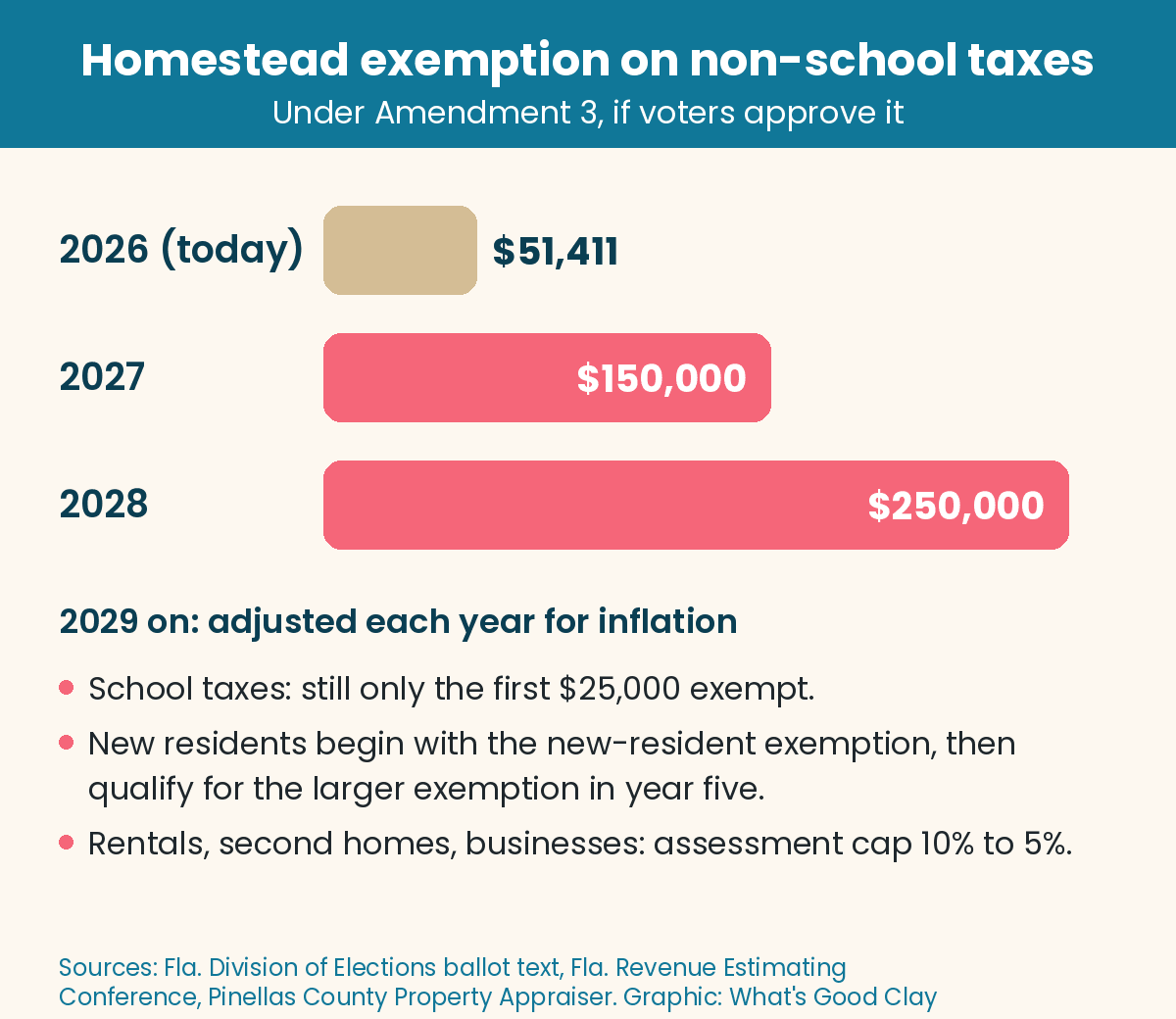 Graphic: What's Good Clay, based on the official ballot text and state estimates. |
How to estimate your own savingsYour TRIM notice from the Clay County Property Appraiser, or your tax bill, lists each taxing authority’s rate in mills. Add up the non-school rates. Then use this formula: (new exemption minus $51,411) × your non-school millage ÷ 1,000. This is an illustration only. It uses the current 2026 exemption levels and assumes future tax rates don’t change. The Pinellas County Property Appraiser uses the same math: an additional $98,589 of exempt value in 2027 and $198,589 in 2028. That works out to about $98.59 a year for every 1 mill of non-school tax in 2027, and about $198.59 in 2028. For example, if your non-school rates add up to 10 mills, the estimated reduction in non-school property taxes would be about $986 in 2027 and about $1,986 in 2028. The full amount applies only if your assessed value, after any other exemptions, is high enough to use the whole new exemption. If it isn’t, your non-school taxable value drops to zero and the reduction is smaller. Your actual result could also change with future millage rates, your eligibility, implementing legislation from the Legislature and non-ad valorem assessments, which exemptions don’t reduce. What state economists project for Clay CountyThe state’s Revenue Estimating Conference projects how much less non-school property tax local governments would collect if tax rates stayed the same. These are estimates, not budget cuts. Local governments could respond by changing rates, fees or spending. For all local governments in Clay County combined, the conference projects about $42.9 million less in fiscal 2027-28 and about $70.2 million less in 2028-29. That grows to about $79.4 million a year by 2031-32. Most of that falls on the county government, at about $40.0 million in 2027-28 and about $74.0 million a year by 2031-32. The projected figure for 2031-32 is about $1.9 million for Green Cove Springs and about $1.8 million for Orange Park. Statewide, the projection reaches about $11.8 billion a year. The county’s budget was already tight. In June, county staff projected a $44.5 million General Fund gap for the coming year, News4JAX reported. That projection came before any Amendment 3 effect and did not include it. Commissioners adopted the 2026-27 budget on Sept. 22. Earlier, they approved a new stormwater fee for developed property in unincorporated Clay County, which took effect Oct. 1. Clay County Sheriff Michelle Cook, who opposes the amendment, said on the News Service of Florida’s Florida Unwired podcast that a $50 million drop in county property tax revenue could cut her budget by about $35 million and mean 250 to 300 layoffs. That is the sheriff’s projection, not a set outcome. As a review by local outlet CN&V noted, her scenario assumes her office would absorb most of that loss and that no other county money would cover it. How any loss is divided would be up to the County Commission during its yearly budget process. What supporters and opponents saySupporters include Florida Realtors, which put $10 million into its Vote Yes on 3 committee. They argue larger homestead exemptions could reduce non-school property taxes for qualifying homeowners and improve affordability. Florida Realtors President Chuck Bonfiglio Jr. said Floridians “need meaningful relief,” Florida Politics reported. Gov. Ron DeSantis also supports the amendment, though it isn’t the version he first proposed, WKMG reported. On Oct. 21, he held a roundtable in Miami advocating for it. Opponents include the Florida Sheriffs Association, the Florida State Fraternal Order of Police, the Florida Professional Firefighters and the Florida League of Cities. They argue lower property tax revenue could pressure local budgets and shift costs through higher tax rates, fees, other taxes or service cuts. The League of Cities calls it “not a tax cut, it’s a tax shift.” Senate President Ben Albritton, who backed putting the amendment on the ballot in June, said on Oct. 20 that he opposes it, Florida Phoenix reported. Renters don’t get a homestead exemption. Critics, including Pasco County Tax Collector Mike Fasano, argue local governments could raise rates to make up lost revenue and landlords could pass higher taxes on through rent, Axios reported. Those are possible outcomes, not certainties. Supporters point to the lower 5% cap on assessment increases for rental and commercial property. Florida Realtors says it gives landlords, tenants and businesses more predictability. What’s still uncertainSeveral details would depend on what happens after the vote. The Legislature would need to pass implementing laws, and it has not yet created the process for counties and cities to raise the exemption further. Your future bill would also depend on the tax rates and fees local governments set each year. That is why no one can give you an exact savings figure today. What to do next
Questions? The Supervisor of Elections office can be reached at (904) 269-6350. |




0 Comments
Join the conversation
Be the first to comment
Share your thoughts above.